


This is my weekly Sunday roundup of new political data published over the last seven days. It is free to read, but if you want to support independent data-driven political journalism, become a paying subscriber and get additional data products and premium analysis at least once weekly.
Hi everyone, Elliott here with a short programming note: I have opened up comments on the Sunday roundups so both paying and free readers can leave questions and recommended links directly to me and the whole community.
If you have a question or comment you want answered/addressed in any Strength In Numbers output, including the podcast, Deep Dives, or free Friday and Sunday articles, leave it below!
1. This is why a midterm convention is a dumb idea, part one
Earlier this month, as “Trumpapalooza” opened in Dallas, I argued the strategic logic of this first-ever midterm “convention” was entirely backwards. Republican strategists like Liam Donovan and Patrick Ruffini said a big Trump-centric gathering would help activate low-propensity Republicans the party needs in November.
The problem with this strategy (and this was obvious in the pre-convention data) is that Republican voters who are not committed to voting in November actually disapprove of Trump more than the Republicans who were already planning to vote. And polls show the issue they care most about is the cost of living — which Trump called a hoax on TV, and no other speakers mentioned. I covered this data on the podcast with David Nir two weeks ago and again in that Friday’s Chart of the Week.
Now our September Strength In Numbers/Verasight poll, fielded Sept. 16–21, gives us a few more data points to assess the success of Trump’s convention. These results have not been released previously.
I have also compiled historical data on news headlines to see if coverage of the convention broke through other stories, much in the way presidential nominating conventions tend to. I’m saving that data for a standalone article to be published tomorrow.
The data here is almost uniformly bad for the president. And in the weeks since the convention, his polls have only gotten worse.
The $5,000 offer backfired
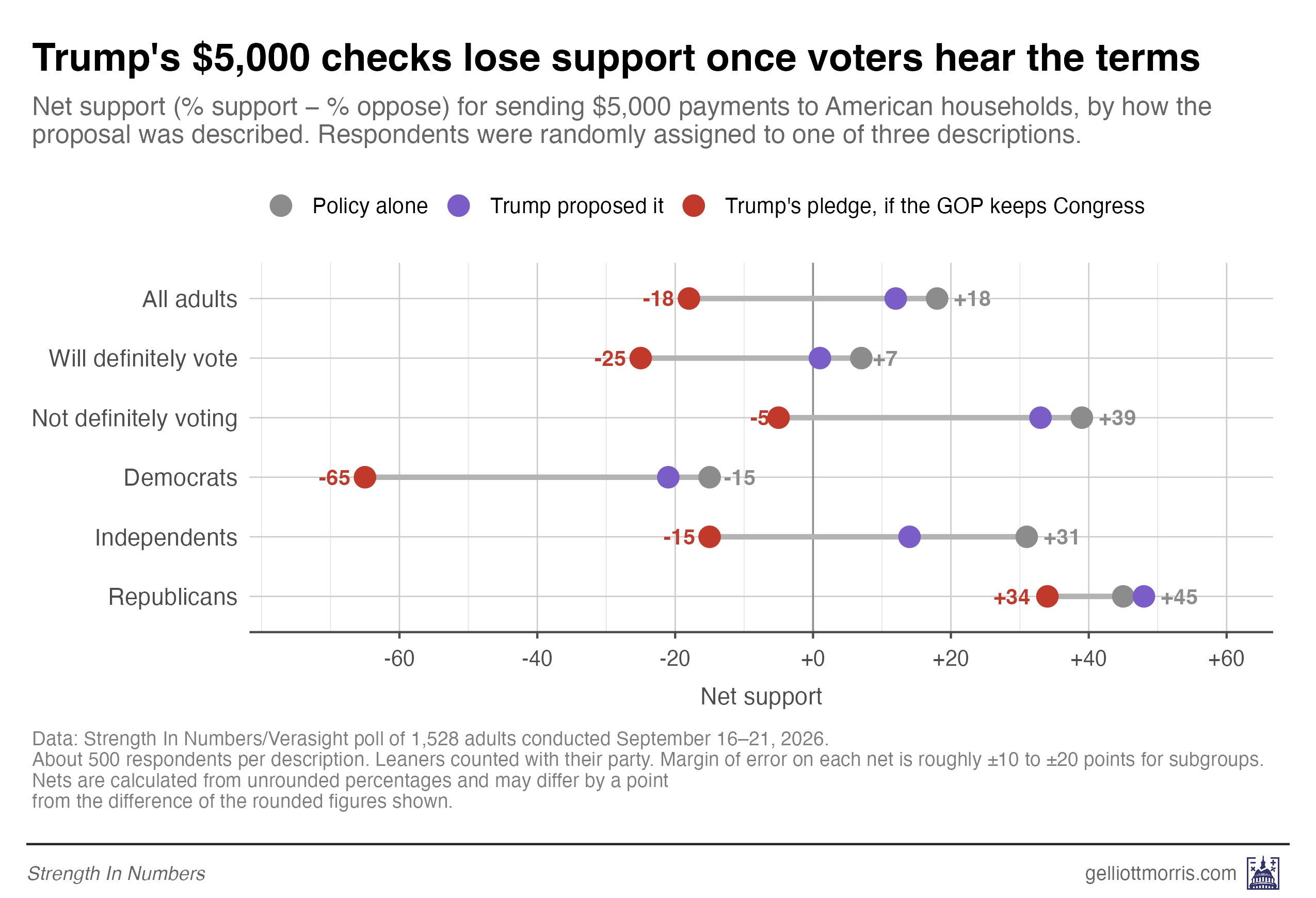
The big story out of Dallas was Donald Trump’s pledge to send every American adult a $5,000 check if and only if Republicans keep control of Congress. This type of thing is tricky to poll about, since people generally support transfers, but we had a reasonable belief the conditioning on GOP victory would turn voters off the idea. So we ran a survey experiment where respondents were broken into three groups: One third of respondents were asked whether they support “sending $5,000 payments to American households,” full stop. A third were told Donald Trump proposed it. And a third got the deal as he conditioned it in Dallas: the checks go out if Republicans win in November.
When the payments were described as a neutral policy, 53% of adults said they supported them while 35% opposed them, a net of +18. When we told voters it was Trump’s idea, support ticked down to +12, a difference inside the margin of error. But when we described the checks as he actually offered them, voters were opposed, at 35% support and 54% oppose, net −18.
And among the voters who didn’t say they were definitely voting this fall — the kind of low-propensity voters the convention was supposed to reach — the swing is bigger still, from +39 to −5.
Voters aren’t confused about the motive, either. 62% say Trump made the promise mainly to win votes in November, and only 13% think he genuinely intends to send the money. Moreover, 71% of adults say it is inappropriate for a president to promise government payments that depend on his party winning an election, including 53% of Republicans. Only about a quarter think the checks would actually go out even if Republicans win.
We also asked voters whether Trump’s promise makes them more or less likely to vote for Republican candidates for Congress. 28% said less likely, 13% more likely, and 53% said it makes no difference. But many voters in that 13% already told us they were voting Republican in November. Fewer than 4% of adults say the checks make them more likely to vote Republican, and aren’t already there. This offsets with large losses among independents, who said by an 11-point margin Trump’s scheme turned them off.
These are bad numbers for what was essentially the only major story from the entire event. In part 2 of this article, publishing tomorrow, I dig into a new database on news headlines shared by the press on social media to show the failure of the convention to act as a forcing mechanism for earned media the way conventions normally do.
For more on this, see the great piece by Seth Masket published last Monday. He shows that the numbers for Trump and Republicans have only decreased since Trumpapalooza (though he uses RealClearPolitics instead of FiftyPlusOne for some reason). Masket makes the correct point that the convention was illogical from the start; vulnerable Republicans need room to run away from Trump this fall, just like blue-dog Democrats tried to distance themselves from Obama in the 2010 red wave.
But a convention built around Trump naturally makes the midterm all about Trump. If you’re a Republican running in a competitive district, this hurts you, because it makes the election all about the guy with a 34% approval rating.
More on this tomorrow, in a standalone piece on this new media headlines dataset I have assembled.
2. What Strength In Numbers published last week
In last Sunday’s roundup, I walked through how to update your beliefs about an election given a new poll, using the Cook Political Report’s battleground-district survey as the worked example. A rough heuristic about how much a single survey is worth is to calculate the distance between that poll result and the current average in a race, and move it toward the new poll by difference * 1/(number of polls in average + 1).

On Wednesday, I released the results of our new September Strength In Numbers/Verasight poll. Trump’s approval in that poll fell to 33% approve, 63% disapprove, his worst reading in the 16 waves of our tracker, driven by opinion among Republicans dropping 11 points in a month. Democrats lead the House vote 52–42 among likely voters:

On Thursday, David Nir and I did a “vibe check” about the blue wave and asked whether this is what past midterm elections have felt like. Are the polls biased again, or can we be reassured in their accuracy by other indicators, like turnout and special elections?

And Friday’s free Chart of the Week looked at our new poll results showing 58% of Americans say the country is worse off today than it was four years ago, including a quarter of Trump’s own 2024 voters. By 56% to 26%, voters say they want a Congress that checks President Trump rather than one that helps pass his agenda:

If you’re a frequent reader of Strength In Numbers, I’m confident you will get a lot of value out of a paid subscription to the site. You’ll get the Tuesday Deep Dive every week, access to a private community for paying members on Discord, and an early look at our monthly Strength In Numbers/Verasight poll before public release.
More than that though, you’ll be supporting original journalism about American politics that is rooted in data that we collect, together, as a community devoted to the importance of public opinion.
3. Even more numbers!
Bryan Bennett compiles 60 years of ANES data on trust in government and shows how skepticism is a core threat to Democratic power in 2028/30. Trust fell from 48% in 2004 to 30% in 2008 and, unlike after Vietnam or Watergate, it never bounced back: it was 16% in 2024. His warning to Democrats is that any majority they win this fall is at risk in 2030 unless they break a two-decade streak of distrust. Democrats Need to Confront the Length and Depth of Distrust in Government and Institutions
The Wall Street Journal reports Republicans are panicking five weeks out (as we covered on Thursday). The Journal’s own poll puts Trump’s approval at 37%, the lowest for any president heading into a midterm in its polling going back to 1990. Trump Is Predicting Midterms Success, but Republicans Are Starting to Panic
Consumer sentiment sank again this month. The University of Michigan’s final September index came in at 48.1, down from 51.7 in August and 55.1 a year ago, and year-ahead inflation expectations jumped from 4.0% to 4.6% on anxieties from fuel prices and new tariffs. University of Michigan Surveys of Consumers
A new Politico poll shows a crack in the GOP base over deportations. The poll shows 31% of non-MAGA Trump voters say the deportation campaign is too aggressive, against 14% of MAGA voters, and 36% of the MAGA base says it isn’t aggressive enough. Poll: A crack is emerging in Trump’s coalition over deportations
Julia Azari shows there’s a contradiction in the political science models of the election. The fundamentals point to big Republican losses (like 40+ House seats), but because polarization “calcifies” voters, the swing is likely to be smaller. Studying for the midterms
Our model at FiftyPlusOne has a median forecast of +25 seats for Democrats.
Rural voters haven’t turned on Trump, but about half of them tell the AP-KFF that the economy is worse than when he took office. They put groceries, gas, and health care at the top of their list of problems. Only half of rural voters approve of Trump’s job as president, well above the national number but below his vote share. Economic frustration tests Trump’s standing with rural voters, new AP-KFF poll finds
And that’s it for this week! Thanks for reading. Strength In Numbers will be back in your inbox on Tuesday.
Comments are OPEN on this post. If you have a question or comment you want answered/addressed in next week’s podcast or another article, leave it below!


Excellent analysis and reporting as usual! There is no doubt that you are the most in-depth analyst available to the general public. I have been concentrating fundraising particularly for the Senate races inasmuch it is rational to believe he will simply ignore and denigrate the Dem House if he can hold on to even a majority of one in the Senate. What do you see with respect to the marvel in Kansas as well as SC, NE, Fl? Media have ignored the probability that Latino shift will substantially decide these three important races? Thank you!
"This type of thing is tricky to poll about, since people generally support transfers, "
Sorry to be a nitpicker, but these are not "transfers" or "payments".
They are BRIBES.
Bribery is what corrupt politicians exert in order to coax people to vote for them.
It is immoral as well as illegal.
And that is the only way this absurd beggary should be defined.